
Spring Terminology
Spring and pressing engineering has its own unique language, and our teams at Lesjöfors understand that spring terminology can differ across regions and industries.
We work closely with customers to make this language easier to understand. Our goal is simple: help every engineer, buyer, and designer choose the right spring for the right application at the right price.
Below is a spring and pressings glossary of common terms from A to Z, created as a practical resource to support your work, wherever you are in the world.
Glossary of springs
A compression spring with a larger middle diameter that helps resist buckling under load. The barrel shape increases stability and distributes pressure evenly during compression. It’s often used in suspension systems and precision mechanical assemblies.
A helical spring designed to resist compressive forces and return to its original length once the load is removed. Compression springs are the most common type, used in machinery, vehicles, and precision equipment. They can be tailored to meet specific load and space requirements.
A spring that forms a cone shape, allowing the coils to telescope into each other when compressed. This saves space and provides greater stability. Conical springs are often used in applications with height limits or progressive spring rates.
A tightly wound coil designed to resist stretching and return to its original position when released. Tension springs often feature hooks or loops for easy attachment. They’re used in machinery, doors, and many industrial systems.
A coiled spring that stores energy through twisting, delivering torque when rotated. It’s commonly used in hinges, levers, and rotational mechanisms. Torsion spring performance depends on coil design, material, and the angle of rotation.
Technical term glossary
When a compression spring bends or deflects sideways under excessive load. Buckling can affect performance and lead to premature wear. Engineers minimize it by adjusting length, coil diameter, or support guides.
The amount a spring compresses or extends under load. It’s a key measure in spring performance, determining how much force the spring can deliver at a given displacement. Accurate deflection control ensures reliable operation.
The expected working life of a spring under repeated loading cycles. Fatigue performance depends on design, material quality, and surface finish. Proper stress management and testing help maximize spring life.
A measure of how resistant a material is to twisting or shearing under stress. It’s an essential property in spring design, influencing flexibility and strength. Different materials have unique modulus values that affect performance.
The stiffness of a spring, measured as the amount of force required to produce a unit of deflection. Higher rates indicate stiffer springs. Engineers adjust rate by changing coil count, wire size, or material type.
This term describes the balance between the lowest and highest stress a spring faces during repeated use. It helps engineers understand how the spring will perform over time. Managing this ratio helps prevent fatigue failure. Designers use it to calculate safe operating limits for each spring type
A controlled heating process that removes internal stresses caused by forming or coiling. It improves dimensional accuracy and enhances fatigue resistance. Stress relief ensures consistent, reliable performance over time.
Flat spring glossary
Small flat spring parts used to hold, connect, or apply pressure between components. They’re often used in electronics, automotive systems, and precision mechanisms. Their shape and material are designed for reliable contact and repeatable performance.
Constant force springs are coiled springs that deliver nearly constant force across their range of motion. It’s perfect for applications that need a steady, smooth force. You’ll often find it in retractable devices or systems that balance weight with precision. The design provides long life and compact performance.
A spring made from flat strip material that deflects when loaded and returns to its original shape. Flat springs are widely used for clips, levers, and electrical connectors. They offer excellent force control in compact spaces.
Leaf springs are a layered, flat-spring design that support heavy loads and absorb shock. Commonly found in vehicles and machinery, it provides flexibility with strong load-bearing capacity. The stacked design distributes stress evenly for lasting performance.
Wire form glossary
Specialized equipment used to bend and shape wire or strip material into defined geometries. These tools ensure accuracy and repeatability in manufacturing. CNC forming machines provide exceptional control for complex wire shapes.
The curvature applied when bending wire, which determines shape accuracy and strength. A larger radius prevents cracking or deformation. Controlling bend radius helps achieve consistent performance in wireform parts.
A custom-shaped wire component used to fasten, retain, or guide parts. Wire forms are versatile, appearing in everything from household appliances to industrial machinery. They combine flexibility with durability to meet unique design needs.
Pressing glossary
Forming metal or wire into a specific angle or curve without cracking the material. Bending defines the shape and strength of pressings and clips. Controlled bending ensures precision and consistency across production runs.
Cutting flat shapes from sheet metal before forming them into finished pressings. This process creates accurate blanks for stamping or pressing. It’s an essential first step in high-volume metal component manufacturing.
A process that uses molds or dies to shape metal into precision stamped components. Pressings can create complex forms with tight tolerances. They’re used across multiple industries, including automotive, industrial, and electronics sectors.
A multi-stage process that cuts, bends, and forms sheet metal into complex shapes. Each die stage performs one operation, creating efficiency and consistency. Progressive dies are ideal for large production runs requiring exact repeatability.
Multi-slide (four-slide) production forms metal using multiple sliding tools that work from different angles, allowing complex bends and shapes to be created with high speed and precision. It’s ideal for producing intricate 3D wire forms and small stamped components with minimal waste and excellent repeatability.
Gas spring glossary
A feature that controls the speed and smoothness of a gas spring’s movement. It allows for controlled extension and retraction, preventing sudden motion. Damping improves safety and comfort in automotive and industrial systems.
The connection points at each end of a gas spring that allow easy mounting. They transfer force to the application safely and efficiently. End fittings are available in various styles to suit different load and alignment requirements.
A sealed cylinder filled with compressed gas that provides controlled force and motion. Gas springs are widely used in cars, machinery, and furniture. They help lift, balance, and control weight with smooth, reliable motion. They offer smooth, adjustable performance and long life.
A piston regulates movement by metering gas and oil through small internal passages, creating controlled damping. It also allows the pressurized gas to push against it, generating the lifting or support force. Together, these functions ensure smooth, stable, and predictable motion.
The central rod that moves in and out of a gas spring to apply or absorb force. It’s precision-machined for smooth travel and minimal wear. A high-quality surface finish ensures consistent sealing and performance.
Spring process glossary
A heat treatment process that softens spring wire to improve ductility and relieve internal stresses. It helps the material bend more easily during coiling or shaping. This step also enhances consistency and performance during production.
Cold coiling is a process where pre-hardened wire is coiled at room temperature before heat treatment. It offers high accuracy and repeatability, making it ideal for smaller wire diameters. Cold coiling is widely used for compression, tension, and torsion springs.
A controlled heating and cooling process that changes the mechanical properties of metal. It’s used to increase strength, hardness, and fatigue resistance. Proper heat treatment ensures springs perform reliably in demanding conditions.
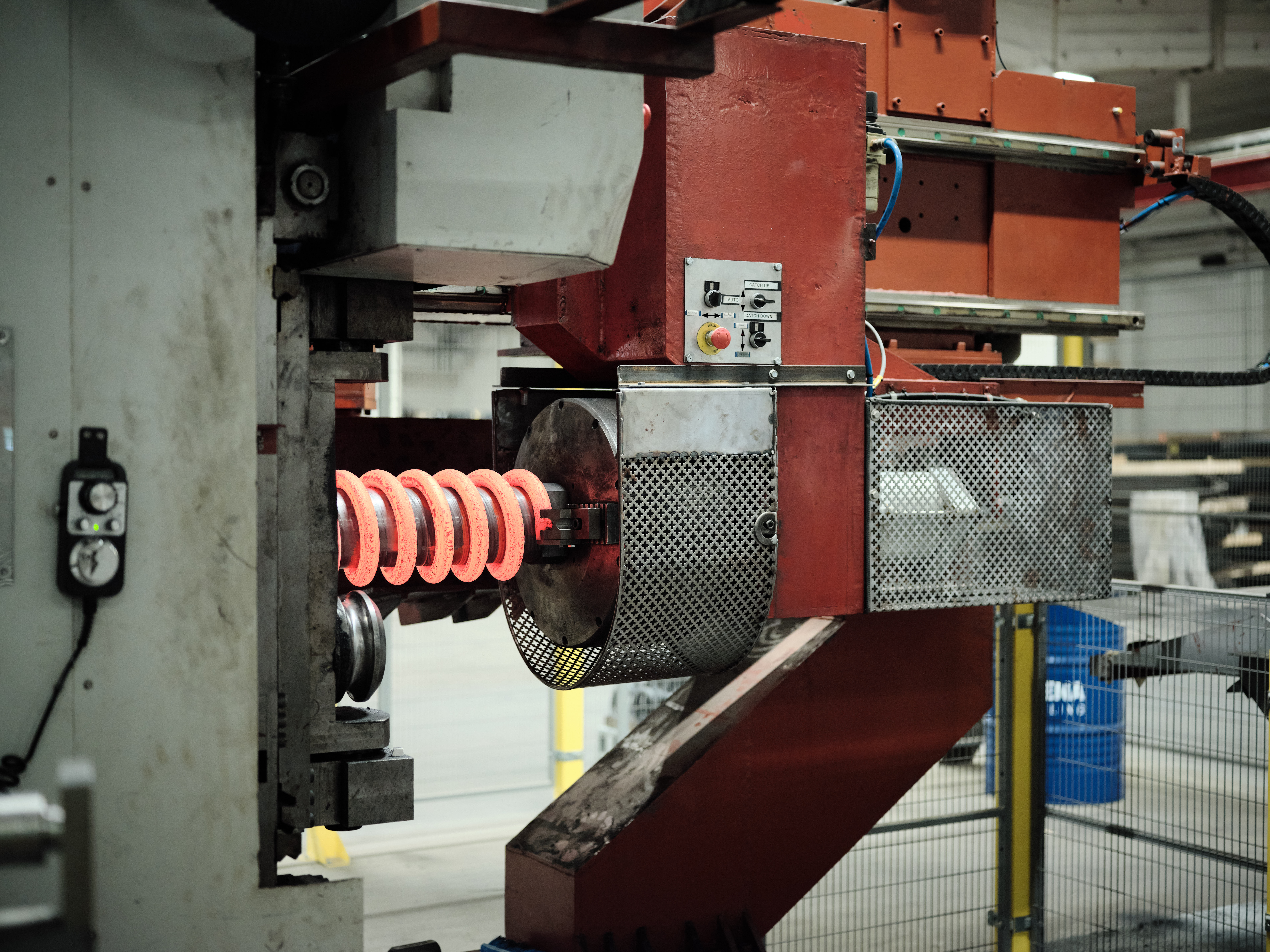
Hot coiling is a method of coiling wire at high temperature (around 900 °C) to produce large or heavy-duty springs. Heating allows tight coiling and complex shapes. This process is used for springs that must withstand extreme loads or environments.
A wire heat treatment process that enhances strength and ductility by refining the grain structure. It prepares wire for drawing and spring coiling. Patented wire offers improved fatigue life and performance.
A coating applied to metal parts to improve corrosion resistance and appearance. Common finishes include zinc, nickel, or phosphate. Plating also enhances surface durability for long-term use.
A gradual loss of force that occurs when a spring is held under constant load over time. This effect can increase with heat or material fatigue. Proper material selection and design help reduce relaxation.
Shot peening is a surface treatment where small steel shots strike the material to introduce compressive stress. It strengthens the surface and prevents crack formation. Shot peening greatly improves fatigue life and durability.
Resources and support
- Learn more about Lesjöfors
About Lesjöfors
- Contact our team of experts
Contact and support
- Explore FAQs and advice
FAQs & technical advice